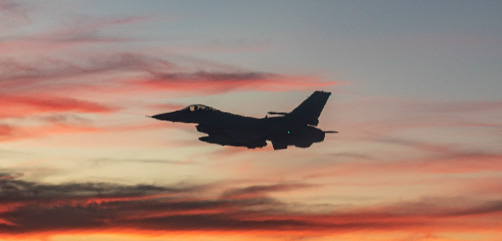
This week the Department of Defense announced the U.S. will begin training Ukrainians to fly and maintain F-16 fighter jets. The training is expected to begin in October at the Morris Air National Guard Base in Tucson, Arizona, and will be facilitated by the Air National Guard's 162nd Wing.
According to the DoD, the U.S. is preempting any training capacity constraints in Denmark and the Netherlands' F-16 training pipeline to ensure the aircraft are fielded to Ukraine as quickly as possible.
The complete U.S. training pipeline will likely take 5-8 months, depending upon the pilots' proficiency coming into the course. The training includes a series of courses ranging from basic flight training to instruction on fighter fundamentals, weapons employment, combat maneuvering and tactical intercepts among other concepts.
Beyond flight training, the F-16s require significant logistics and maintenance training for ground support personnel that ensures the aircraft remain combat capable.
All of the above starts with assuring everyone (trainers, trainees, ATC, etc..) can freely communicate in a common language with the added field-specific, platform-specific lexicon. Thus, prior to flight training, the pilots will receive English language training at Lackland Air Force Base in San Antonio, Texas beginning in September.
According to the Institute for the Study of War:
Ukrainian forces continue counteroffensive operations near Robotyne in western Zaporizhia Oblast and are advancing. Russian milbloggers are expressing concern over a lack of reinforcements and troop rotations in the area. There are also reports of a Russian unit suffering significant losses due to inadequate support on an island in the Dnipro River delta. There is growing outrage against the Russian military command in some parts of the Russian information space.
According to the UK Ministry of Defence:
The Ukrainian counter-offensive has put Russian forces under pressure in Bakhmut and southern Ukraine. Despite this, Russia’s Western Group of Forces has continued small-scale attacks in the north-east, in the Kupiansk-Lyman sector, and has made some limited local advances.
As Ukraine continues to gradually gain ground in the south, Russia’s doctrine suggests that it will attempt to regain the initiative by pivoting back to an operational level offensive. Kupiansk-Lyman is one potential area for this.
There is a realistic possibility Russia will increase the intensity of its offensive efforts on the Kupiansk-Lyman axis in the next two months, probably with the objective of advancing west to the Oskil River and creating a buffer zone around Luhansk Oblast. |