For nearly seven decades, the Cuban regime has pursued a strategy of subversion against the United States, relying on espionage, ideological recruitment, and proxy networks rather than conventional military force. This approach has shaped extremist movements within our borders and continues to pose risks to critical infrastructure and enforcement operations.
On Monday, the US State Department released a new report titled Cuba: The Capital of 21st Century Communism, which details an influence operation developed by a coalition of more than 60 U.S. groups linked to the government in Havana. The plan calls for coordinated nationwide protest actions within 24 hours of any military attack on Cuba or the “imminent threat” of one.
This topic is particularly noteworthy given recent developments in Cuba and President Trump’s statement that “a lot of things are going to happen in Cuba” over the next several months. Although Trump said he did not expect events to unfold as they had in Venezuela, his remarks have intensified speculation about increased U.S. pressure on Havana.
The National Rapid Response Plan
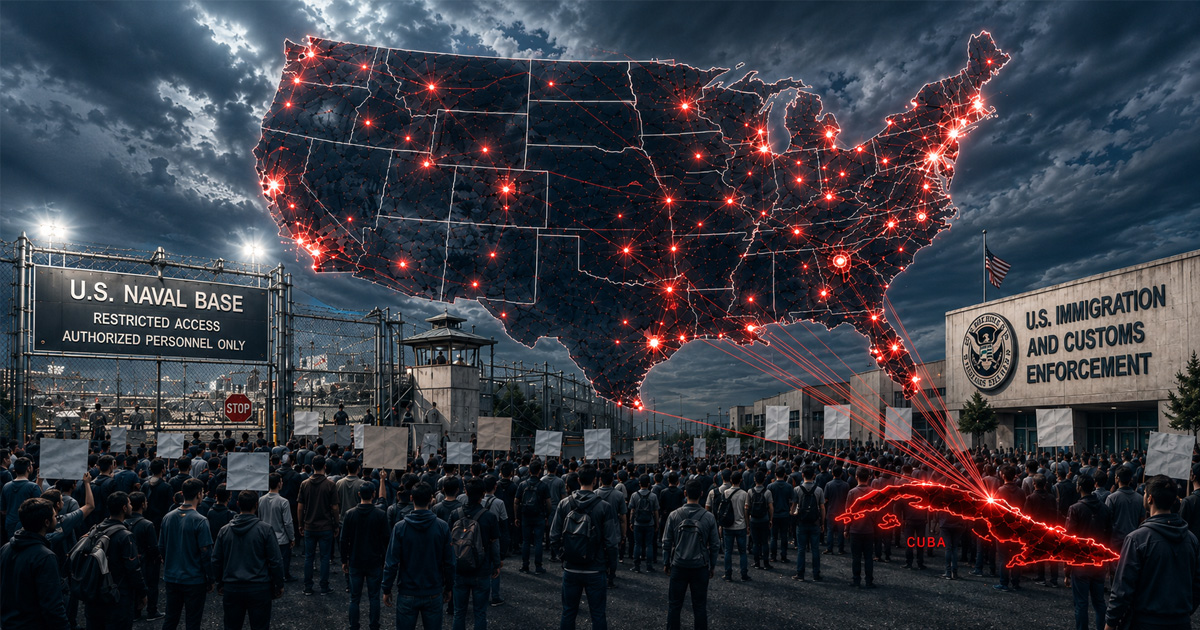
The June 2026 “National Rapid Response Plan,” distributed by the National Network on Cuba, aims to make military operations against Cuba “politically and materially costly for the U.S. government.” Targets include U.S. military bases and recruitment offices, federal buildings, ICE detention centers and field offices, and even sports arenas during high-visibility events. Organizers are directed to a map of 1,335 military and law-enforcement sites compiled by the Black Alliance for Peace. Demonstrations at immigration facilities are framed as linking “Cuba solidarity” to broader anti-ICE efforts. Mobilization follows a simple but strict timeline: if the triggering action occurs before 3 p.m. Eastern time, demonstrations begin at 6 p.m. local time the same day; otherwise, they start at 6 p.m. the following day.
Organizers are instructed to activate local affiliates across time zones through pre-established communication channels, ensuring simultaneous pressure in multiple jurisdictions.
Risks to Military and ICE Operations
For law enforcement and intelligence professionals, the plan amounts to a ready-made system for rapid, coordinated disruption at key security sites. Concentrated protests at military installations could interfere with base security, readiness, logistics, and personnel movements. At the same time, pressure on ICE facilities risks pulling resources away from interior enforcement and detention operations.
The wide geographic spread of the targets, combined with the 24-hour activation window, raises the likelihood of simultaneous incidents that could strain local, state, and federal response capacity. Agencies would face overlapping demands for force protection, traffic control, and maintaining public order across widely scattered locations.
Secondary effects could include opportunistic crime near protest sites, increased strain on emergency services, and the need for quick intelligence assessments to separate lawful assembly from coordinated efforts meant to impose domestic costs on U.S. foreign policy. Because the network already spans existing activist, legal, and advocacy organizations, activation does not require new recruitment or last-minute planning—the infrastructure is already in place.
Why the Public Should Pay Attention
The public should understand that this is more than abstract advocacy. It is a prearranged mobilization mechanism intended to increase the domestic political and operational costs of U.S. action against Cuba by concentrating protests and demonstrations at sensitive or highly visible locations.
Lawful assembly remains a constitutionally protected right. Nevertheless, the deliberate focus on military installations, immigration-enforcement facilities, federal buildings, and major public venues creates legitimate concerns involving facility security, force protection, access control, traffic disruption, emergency response, and public order.
Recent mass-mobilization campaigns have also shown that otherwise lawful demonstrations can be exploited by smaller groups seeking confrontation, property damage, unlawful entry, or interference with government operations. Continued intelligence monitoring, interagency coordination, and contingency planning will be necessary to distinguish protected political activity from conduct that threatens personnel, facilities, or essential operations.
|