While the nation's attention has been focused on war in the Persian Gulf and Middle East, peer adversaries have been busy elsewhere in the world.
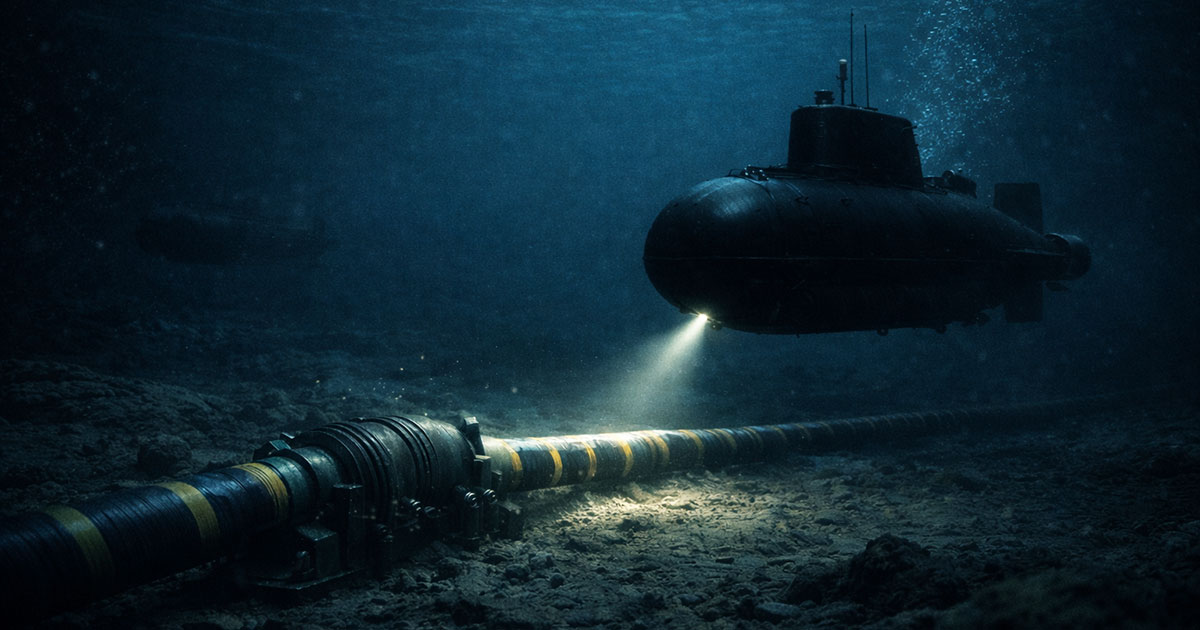
On Monday, April 6th, UK Defense Secretary John Healey disclosed a significant Russian underwater reconnaissance and possible sabotage operation in the North Atlantic, north of the United Kingdom, which prompted a sustained allied response. In an unprecedented Downing Street press conference, Secretary Healey confirmed that British, Norwegian, and other NATO partners tracked a Russian Akula-class nuclear-powered attack submarine and two specialist vessels from Russia’s Main Directorate of Deep Sea Research, known as GUGI, for more than four weeks.
Distraction Timing
The Russian activity occurred in international waters and the UK’s Exclusive Economic Zone and was focused on critical undersea infrastructure, including fibre-optic cables and oil and gas pipelines. These assets carry a significant amount of international data traffic, underpinning global finance, trade, and communications. The operation appeared timed to exploit Western focus on developments in the Middle East and Persian Gulf, with the Akula-class sub serving as a diversionary presence while the smaller specialized platforms conducted closer reconnaissance.
The UK response included at least one frigate, a support tanker, Merlin helicopters, and RAF P-8 Poseidon maritime patrol aircraft, which flew hundreds of hours while deploying sonobuoys for persistent acoustic tracking. The effort combined overt shadowing to deny the Russians operational secrecy, along with close allied coordination, particularly under agreements between the UK and Norway. No damage to the underwater infrastructure was detected, and all three Russian platforms eventually withdrew northward toward their bases.
Secretary Healey delivered a direct message to President Putin:
“We see your activity over our cables and our pipelines… any attempt to damage them will not be tolerated and would have serious consequences.”
While there has not been so much as a peep from anyone about U.S. involvement given recent tensions with Britain over the use of bases for the Iran conflict, it is very likely. Undersea domain awareness missions frequently involve close-hold intelligence sharing and unacknowledged support from Five Eyes or bilateral partners. Said differently, while the politicians may be fighting, defense partnerships remain steadfast.
UK Public Warning
What is particularly interesting is the UK’s high-level public disclosure, unusually detailed and delivered by the Defense Secretary. This indicates that intelligence and operational assessments judged this Russian deployment to be significantly more threatening than routine High North activity. Standard submarine transits or occasional Russian surveys very rarely prompt ministerial statements.
Additionally, a month-long, coordinated effort involving a diversionary Akula-class nuclear submarine shielding two specialist deep-sea research platforms directly over critical undersea infrastructure suggests deliberate, persistent seabed interaction at a scale that crossed an internal threshold. Somewhere, alarm bells sounded very loudly. By publicly revealing the operation while the vessels were still being tracked or immediately upon their withdrawal, London stripped Moscow of the operational secrecy and deniability it typically seeks in grey-zone missions, particularly at a moment when Western strategic focus was divided with Middle East developments.
The move also served as a calibrated deterrent signal without escalating to kinetic confrontation.
Sabotage Devices
Defense and intelligence professionals have long warned of GUGI's unique mandate and equipment for enabling the particularly insidious hybrid tactic of the peacetime placement of dormant sabotage devices for wartime activation. The two specialist vessels in this situation are reportedly capable of deploying miniature unmanned underwater vehicles or remotely operated systems that can affix acoustic sensors, fibre-optic tapping pods, small shaped charges, or cutting devices directly onto or adjacent to pipelines and data cables. Once positioned, such “sleeping” assets could remain undetected on the seabed for months or years, activated remotely or by preset timers when Moscow chooses to degrade NATO’s transatlantic lifelines.
In a future high-intensity conflict, these pre-placed devices would allow rapid, deniable disruption of major portions of internet traffic and critical energy supplies.
While the UK Ministry of Defense reported no immediate damage or confirmed device deployment in this episode, the prolonged proximity and survey-like behaviour of the GUGI platforms has sharpened allied concern that preparatory emplacement may already have occurred, underscoring the urgent requirement for persistent seabed monitoring.
|