Threat Journal Logo Banner - ALLOW  IMAGES
Jan 24, 2026
A weekly supplement to the AlertsUSA
National Threat and Incident Notification Service
for Mobile Devices
   
PODCAST - Listen to this issue. - ALLOW IMAGES
WEEKLY THREAT AND ALERT ROUNDUP
Published Each Saturday
 
On the flight deck of the Nimitz-class aircraft carrier USS George H.W. Bush (CVN 77) in the Atlantic Ocean. - ALLOW IMAGES

Bases in the Crosshairs: Iran Proxies Threaten US

Jan 24, 2026
What You Need To Know

Strain between the United States and Iran has intensified in the week since widespread anti-government protests erupted across the Persian Gulf nation, with a reported death toll exceeding 5,000 amid a harsh state crackdown. In response, Washington has renewed warnings and threats of intervention, while Tehran has vowed massive retaliation against American forces and regional allies.

Iran-aligned proxies, including Kataib Hezbollah, have amplified threats against US bases, and Tehran has mobilized forces, raising the risk of a broader conflict that could disrupt oil supplies, endanger US troops, and draw in regional powers such as Israel and Gulf states. Diplomatic efforts have stalled, leaving both sides preparing for potential strikes.

The central danger is an escalation spiral driven by miscalculation: US coercive measures tied to Iran’s internal crackdown could prompt asymmetric Iranian retaliation, which then triggers defensive US escalations. A weakened Iranian regime may choose high-risk options such as missile strikes on US bases or attempts to disrupt the Strait of Hormuz, a chokepoint that handles roughly 25% of global oil trade. Either step could internationalize the conflict and threaten the approximately 40,000 US troops in the region.

Tightening Force Protection and Defensive Posture

Embassy warning messages across the region increasingly signal that “force protection” is now operational rather than theoretical. Partial evacuations of non-essential personnel from key bases, including Al Udeid in Qatar, have continued as a precaution against Iranian missile threats. US citizens are being urged to exercise extreme caution, avoid protests, and prepare for rapid departures.

Regional air and missile defense is being organized for real contingencies. Last week, CENTCOM announced that it and “regional partners” opened a new air-defense coordination cell at Al Udeid to improve coordination, integrate air and missile defense, and share threat warnings. Together, these steps indicate more than symbolic deterrence: the United States is building a layered defensive and command-and-control posture that assumes potential missile and drone retaliation against bases and critical infrastructure.

Military Buildup and Explicit Threat Signaling

The overall repositioning has been described as matching or exceeding the 2025 buildup prior to strikes on Iran’s nuclear facilities. Multiple carrier strike groups are moving toward the region, alongside additional assets such as advanced fighter aircraft, tankers, transport aircraft, Patriot and THAAD systems, and rocket artillery. US destroyers and mine countermeasures ships are already operating near the Strait of Hormuz, positioning for possible escalation.

Tehran has responded with explicit warnings. IRGC Commander General Mohammad Pakpour said forces have their “finger on the trigger,” while senior officials have labeled US interests as targets. IRGC-linked media circulated a video highlighting facilities across multiple regional states within missile range. Foreign Minister Abbas Araghchi, in a Wall Street Journal op-ed, vowed “full-force retaliation,” promising a ferocious response and citing unused missile stockpiles from the 2025 war.

Washington has maintained a firm posture, emphasizing that all options remain on the table to address Iran’s actions and prevent further escalation. Tensions peaked on Thursday in Davos, where President Trump referenced the 2025 strikes on Iran’s nuclear sites and said the US would act again if needed. He also warned Iran against assassination attempts and threatened overwhelming consequences.

Escalation Pathways and What to Watch

If there is one mechanism most likely to harm Americans quickly without a formal declaration of war, it is attacks by Iran-aligned militias on US personnel and facilities in Iraq, Syria, and Gulf partner states. Kataib Hezbollah has explicitly threatened US bases if Washington strikes Iran. Long War Journal reports the group warned it would attack American bases in Iraq and the region using missiles and drones, delivering the message at a rally outside Iran’s embassy in Baghdad.

This creates a familiar escalation ladder: the US moves assets and issues threats to deter Iran or compel behavior; a proxy actor attacks (or attempts to attack) a US base; Washington retaliates to restore deterrence and protect forces; and Iran responds directly or via additional proxies, expanding the target set.

Even without a declared war, the Gulf can become uninsurable or disrupted if harassment or attacks on shipping rise. That tends to generate rapid economic and political pressure, increasing incentives for kinetic action framed as restoring freedom of navigation, especially given oil-market sensitivity to these tensions.

Beyond US–Iran dynamics, the regional architecture makes it likely that Israel and Gulf partners would be targeted in a retaliation scenario—directly or through proxies—raising risks for US citizens in those countries as well.

Observable indicators that the situation is shifting from “deterrence posture” to “pre-strike posture” would include further base posture changes (restricted movement, extended sheltering guidance, additional evacuations), expanded air-defense deployments, a surge in militia attack attempts in Iraq and Syria, and Iranian moves affecting aviation or maritime traffic—signals markets often interpret as pre-conflict messaging.

The Bottom Line:

The US military posture is now substantial and increasingly integrated with regional air and missile defense, functioning as more than a warning. At the same time, Tehran and Iran-aligned militias are explicitly framing US bases as legitimate targets if Washington strikes Iran. The result is a tightening tripwire environment: more assets, more alerts, more rhetoric, and more actors who can initiate violence on short notice.

For US citizens in the region, official security alerts should be treated as actionable: reduce exposure to military facilities, track mission messages closely, and assume disruptions to airspace, ports, and communications could occur quickly.


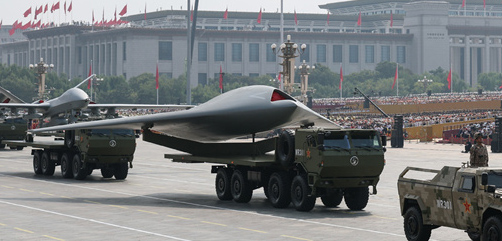
Deterring China in an Age of Hard Choices - ALLOW IMAGES
Commentary / Analysis / Research
Jan 24, 2026

Deterring China in an Age of Hard Choices

The margin of deterrence against China is rapidly shrinking, driven not by a failure of US technological innovation, but by the American and allied defense industrial base’s inability to field and sustain cutting-edge capabilities at scale, at speed, and under constant pressure.

This article argues that defending vital US interests requires a comprehensive focus on systemic vulnerabilities that offer the fastest path to defeat, chiefly the brittleness of scouting (C4ISR) and logistics networks. The most time-sensitive industrial investments are in munitions, to close a widening missile gap; drones, to compete with China's mass production; and submarines, to address the profound crisis in the attack submarine force’s industrial capacity and sustainment.

~ READ MORE HERE (TNSR) ~

The U.S. Is the Sole Superpower

The stunning U.S. military operation on January 3, 2026, that captured Venezuela’s Nicolás Maduro and his wife, Cilia Flores, was not merely a counternarcotics raid or an act to remove a dictator who had illegally assumed power after losing an election. It was a deliberate strike against the emerging multipolar world order. By removing Maduro from power, bringing him to face justice in New York on narco-terrorism charges, and signaling direct U.S. influence over Venezuela’s vast oil reserves, President Trump has sent an unmistakable message: The United States will not tolerate a global landscape where adversaries like China, Russia, and Iran carve out spheres of influence at America’s expense.

~ READ MORE HERE (RCD) ~

2026 National Defense Strategy

The 2026 National Defense Strategy adopts an "America First" approach centered on peace through strength and homeland defense as the top priority—including border security, counter-narcotics, protection of key Western Hemisphere assets (e.g., Panama Canal), and nuclear/cyber modernization. It identifies China as the pacing threat, emphasizing deterrence through denial capabilities in the Indo-Pacific without direct confrontation, while demanding far greater allied burden-sharing (targeting 5% GDP defense spending). The strategy shifts away from global overextension and nation-building, treats Russia as a secondary/manageable challenge for European partners, and calls for urgent revitalization of the U.S. defense industrial base via re-shoring, innovation, and mobilization to restore readiness and unilateral decisiveness.

~ READ MORE HERE (DoD/DoW) ~


Book Ad: Al-Qaeda 2.0: The Upcoming Attack on the United States and Europe Unveiled

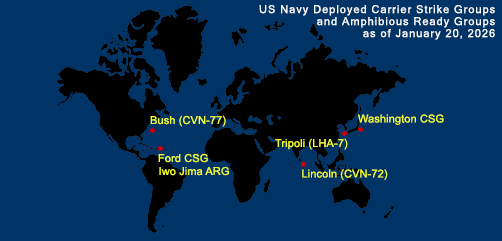
Fleet and Marine Tracker Map as of January 20, 2026.  - ALLOW IMAGES
U.S. Navy Fleet and Marine Tracker
As of January 20, 2026

These are the approximate positions of the U.S. Navy’s deployed carrier strike groups and amphibious ready groups based on U.S. Navy briefings, public data provided by the U.S. Naval Institute, and open source reporting. Map does not reflect this week's deployments.


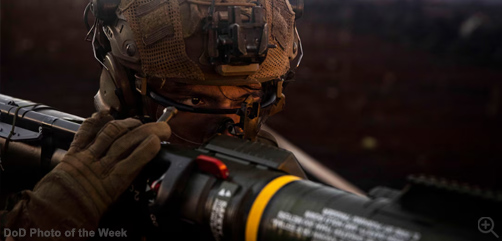
Marine Corps Lance Cpl. Orlando Florez engages simulated targets with an M136 AT4 light anti-armor weapon system during a live-fire training event at Pohakuloa Training Area, Hawaii, Jan. 15, 2026.  Image: DoW - ALLOW IMAGES.
World News Roundup
Jan 24, 2026

PUBLIC HEALTH

Pediatric vaccine empire slammed with a federal RICO lawsuit

AMERICAS

Purdue blocks admission of many Chinese grad students in unwritten policy
Trump orders ‘25 brand new’ B-2 bombers, more than doubling arsenal
DHS plans to rearrest and deport Columbia protest leader Mahmoud Khalil
ICE using sweeping power to enter homes without a judge’s warrant
ICE targets Somali communities in Maine in new administration crackdown
Democrats seek to block Homeland Security funding over ICE concerns
DHS / ICE make 3000 arrests, removing the worst from Minneapolis streets
DHS calls for tips on two criminal illegal alien sex offenders in St Paul, MN
Colombia halts electricity sales to Ecuador and imposes tariffs in trade spat
Firefighters face attacks while battling deadly blazes in Chile

EUROPE

New US defense strategy downgrades Europe, elevates Greenland
Top NATO commanders standing by for policy guidance on Arctic mission
Bosnia: How a small defense industry became Europe's hidden supplier
Poland upgrades navy against Russia's Baltic threat
Russia watches tensions over Greenland with glee, gloating and wariness
What we know about Trump's 'framework of future deal' over Greenland
Germany expels a Russian diplomat after espionage arrest
Denmark sends more troops to Greenland amid tensions with Trump
Europol rolls up 24 drug labs and arrests 85 in large sting operation
Zelenskyy warns Europe Trump peace deal will be failure without Ukraine

MIDDLE EAST / AFRICA

Death toll in Iran’s crackdown on protests reaches at least 5,002
Internet shutdown squeezes Iran’s businesses as protests continue
Jihadist attack claims lives of eleven police officers in Burkina Faso
Israel expands arming of settlers with new licences and preparedness units
Israel bulldozes UNRWA headquarters in East Jerusalem
Israel army says it struck Hezbollah sites in southern Lebanon
UN rights chief says Sudan’s people endure horror and hell amid war
IAEA chief says standoff with Iran over nuclear inspections cannot last forever
Three journalists among 11 Palestinians killed by Israeli forces in Gaza
Uganda detains 2,000 opposition supporters, kills 30 after disputed election
Sudan war drives a deepening humanitarian catastrophe
Nigeria kidnappers demand motorcycles as ransom for 150+ hostages
Ambush in northwest Nigeria kills five soldiers and one police officer
Car bomb in Yemen kills 3, intended for leader of Saudi-backed group

ASIA / OCEANIA

3 killed in shooting in Australia, manhunt under way
China flies drone into Taiwan’s airspace for first time
The Chinese spy machine infiltrating Taiwan’s military
Taiwan detains journalist for allegedly bribing military officers
Chinese tourists shun Japan in wake of Taiwan invasion row
Japan and PI sign new defense pact in face of Chinese aggression
Cambodia files new protest over Thai infringement near border
Myanmar junta kills 27 civilians in airstrikes on wedding and funeral


Alert! Symbol - ALLOW IMAGES

Travel Security Resources


We want your feedback! Let us know your thoughts on today's issue.
Write us at service [at] alertsusa.com

Copyright © 2011-2026 AlertsUSA Inc.
NOTE: If URLs do not appear as live links in your e-mail program, please cut and paste the full URL into the location or address field of your browser. Disclaimer: Threat Journal and AlertsUSA, Inc., may from time to time recommend products that we've either personally checked out ourselves, or that come from people we know and trust. For doing so, we receive a commission. We will never recommend any product that does not have a 100% money-back satisfaction guarantee. Nothing in this e-mail should be considered personalized Financial Advice. No communication by our employees to you should be deemed as personalized Financial Advice. Any investments recommended in this letter should be made only after consulting with your investment advisor and only after reviewing the prospectus or financial statements of the company. Nothing in this e-mail should be considered personalized Health Care Advice. Although our employees may answer your general customer service questions, they are not licensed health care professionals. No communication by our employees to you should be deemed as personalized Health Care Advice. Any Health Care recommended in this letter should be made only after consulting with your Doctor and licensed Health Care Advisor.

Ezekiel 33:3 - "Then if anyone hears the trumpet but does not heed the warning and the sword comes and takes their life, their blood will be on their own head."


AlertsUSA on Spotify AlertsUSA on Apple Podcasts AlertsUSA Threat Journal Homeland Security Weekly Update podcast feed. AlertsUSA on SoundCloud